 Audiogravity
8. Updating
Audiogravity updates itself from the browser — no terminal, no re-running scripts.
One-click self-update
When a newer release is available, the Admin page shows an update banner with the new version, a release-notes link, and a required badge if the update is critical. You don't need the page open to notice: the Admin tab itself carries a small download marker whenever an update is waiting — in the warning colour when it is required.
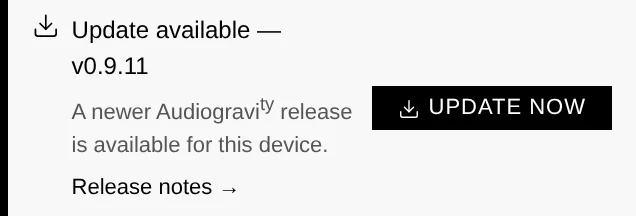
Installing it is one action:
- A short confirmation (playback briefly stops) and your admin password.
- The box downloads the new version, swaps the binary, and health-checks that it comes back up on the right version.
- Live progress the whole way — downloading → installing → verifying — even across the service restart.
On an all-in-one box, the same click updates the core and the interface together, so everything lands on the new version at once.
While software is being installed on the box — from Audio Software, the Terminal tab or over SSH — the update is refused, with a message naming what is being installed. Try again once it has finished.
Safety: automatic rollback
If anything goes wrong, the box automatically rolls back to the previous version and tells you why, under the update banner — you're never left on a broken update. There's no OS reboot; only a brief pause while the audio service restarts.
Split installs (different hosts)
One-click self-update covers a co-located core + ui. If your core and interface run on different hosts, update each side separately (see below) — the one-click action updates the box it runs on.
Manual update
You can always update by re-running the installer; your configuration is preserved —
both .env and your files under /etc/audiogravity (the signal-chain map, and your saved
radio stations). A fresh install seeds those files with sensible defaults; an
upgrade never overwrites them, so your edits survive. The services and profiles are
the exception: they come with each version, and the installer puts them back every time
it runs (see 7. Administration):
curl -fsSL https://audiogravity.app/install.sh | sudo bash
Version-mismatch banner
If the interface and the core end up on different versions (for example after a partial or multi-host update), a banner appears in the Admin tab prompting you to update the other component. It's silent when the two match.
Backup & restore
Everything that makes your box yours lives in a handful of files. Copy them before an OS reinstall (or on a schedule) and you can rebuild the box in minutes:
| What | Where |
|---|---|
| Audio setup — hi-fi chain map, saved radio stations | /etc/audiogravity/ (audio-topology.json, radio.json) |
| Your licence and its public key — valid on this installation only (see below) | /etc/audiogravity/audiogravity.lic, license.pub |
| Accounts — users, roles, password hashes, passkeys | /opt/audiogravity/core/users.json |
| Core runtime config — API key, security secrets, enabled modules | /opt/audiogravity/core/.env |
The simplest habit — grab everything in one archive:
sudo tar -czf ag-backup-$(hostname)-$(date +%F).tar.gz \
    /etc/audiogravity \
    /var/backups/audiogravity \
    /opt/audiogravity/core/users.json \
    /opt/audiogravity/core/.env
Restore on a fresh install: run the installer first (see 2. Installation), then unpack the archive over the new files and restart the core:
sudo tar -xzf ag-backup-….tar.gz -C / --exclude=etc/audiogravity/audiogravity.lic \
    --exclude='etc/audiogravity/audio-config.json*' \
    --exclude=etc/audiogravity/packages-registry.json \
    --exclude=etc/audiogravity/packages-config.json
sudo systemctl restart ag-core-server
Service config files regenerate through the guided setup, and streaming-service logins are simply re-entered in Library → Sources. Your music itself lives on the NAS/USB drive — it is never stored on the box.
The licence file is left out on purpose: it only matches the installation it was activated on, and a reinstalled system has a new Device ID. Brought back, it would be refused, and would keep the free trial from starting. To have your licence reset, see 9. Troubleshooting.
The services and profiles, and the list of audio software, are left out too: they come with the version you install, and the archive's would bring back those of the version you backed up.
Editor-level backups (the timestamped copies the Config editor keeps before every save) live under
/var/backups/audiogravity— that's why the archive above includes it.